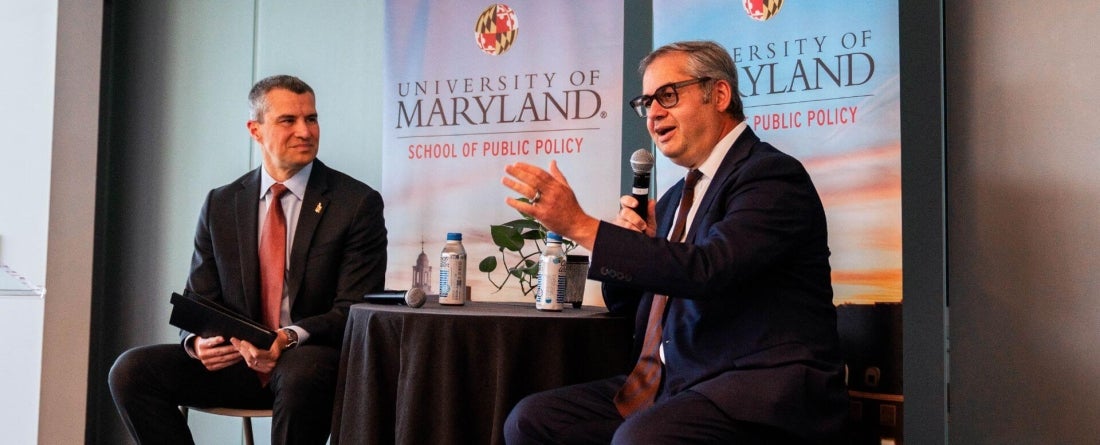
The School of Public Policy welcomed Ambassador Khazar Ibrahim of Azerbaijan for a Norman and Florence Brody Family Foundation Public Policy Forum on energy, geopolitics and shifting global dynamics.
Ibrahim joined Dean Gustavo Flores-Macías for a moderated discussion on Azerbaijan’s position between Europe and Asia and its growing role in energy and regional trade. The conversation brought students, faculty and members of the broader community together to discuss regional conflict, global trade and the future of international cooperation.
Brody Professor Betty Duke delivered opening remarks and reflected on the forum’s role in bringing policymakers and practitioners to campus to engage students beyond the classroom.
Flores-Macías said the conversation comes at a time of heightened uncertainty globally. “As global dynamics continue to shift … Azerbaijan sits at a vital crossroads geographically, politically, economically, between Europe and Asia.”
Ibrahim spent much of the conversation on the South Caucasus, calling it a turning point for the region. After decades shaped by outside powers, he said Azerbaijan, Armenia and Georgia now have more control over what comes next. “For the first time, three countries can actually have the ownership for our own future,” Ibrahim said.
He described Azerbaijan’s approach as one centered on cooperation and long-term economic ties. “Let’s work with bigger powers, with banks, not tanks,” said Ibrahim.
That approach extends to energy and trade. Ibrahim highlighted Azerbaijan’s role in supplying natural gas to Europe, particularly following disruptions linked to the war in Ukraine, and emphasized Azerbaijan’s efforts to remain a reliable partner. He also pointed to investments in transit routes connecting Asia and Europe, including rail and port projects built ahead of rising demand. “We were looking into the future,” said Ibrahim.
While discussing energy transition, Ibrahim emphasized the need for a gradual shift that still accounts for current global demand. “We believe you need to have a transition,” he said, noting the continued role of natural gas alongside expanding renewable capacity.
Ibrahim described Azerbaijan’s broader foreign policy as balanced, maintaining partnerships with the United States, the European Union and China. At the same time, he offered a straightforward assessment of the broader international system. “We do not have a rules-based international order today,” he said.
During the audience Q&A, Ibrahim returned to the role of diplomacy and the importance of credibility in international relationships. “You can trick somebody today for tactical gains, but you will lose strategically,” he said. “Trust is the most important thing.”